

This Draft Model Beats Front Offices. Here's What It Says for This Year
Quantifying against (or for) consensus

I’ve been waiting for months to get this one out, and it’s finally the right time! With the 2026 NBA Draft coming up on Tuesday, the time has come for me to showcase the results of my draft model that I’ve been working on.
Like any model, it’s not perfect — and you’ll see some examples in a moment — but it beats the average front office overall. In other words, it’s typically better than what teams have done in the past with their picks, so much so that it would have identified some pretty big stars (and pretty big busts) before they actually turned into what they became.
I do want to say one thing, however: This is not my mock draft — very much not. There are some picks as a result of the model that I would not make in real life, primarily because I believe in the power of intangibles and immeasurable traits. Plus, this doesn’t take into account team fit, and while many subscribe to the Best Player Available theory, I find myself, while leaning toward BPA, sprinkling in a bit of team fit as well. Primarily, the model is meant to make you think twice about some guys, not to drastically change where you pick them.
Before we dive in — and if you’re not interested in how the model was built, feel free to skip this section — let’s talk about some aspects of the model that give it its shape. Some people don’t like to explain how their models work, and while I won’t explain everything here, I will give some insight. After all, there’s nothing new under the sun, right?

Some Basic Draft Modeling Traits
Most draft models tend to lean one of two ways: Stats-only, and, well, not stats-only. A stats-only model is one that strictly looks at a player’s college statistics and nothing else, using that to determine how good a player is and their draft worthiness relative to their class. The other version — not stats-only — can involve any other variables. A common one is NBA Combine metrics, but you can run the gamut on this. For this model, I’ve included a player’s projected pick via the consensus of multiple mock drafts. Why? Because, typically, NBA GMs get it right more than stats-only models do, at least in the public sphere (maybe there’s a model out there that OKC has access to that does better, who knows!).
Using that mock draft pick as a prior (the term for what is essentially an anchoring variable), you’re able to give a sense of reality to your model. Instead of having Chuma Okeke at #3 (as Kevin Pelton’s stats-only model did, which, importantly, was not his final ranking, and he’s a great draft modeler), you’re able to more accurately project where he should go given where teams are expected to pick him.
Then, you wrap everything into a machine learning model, the details of which I won’t go into here, and you do some testing.
How The Model Predicted The Past
Using something called out-of-fold (OOF) validation, we can identify how the model would have picked in the past, which gives us a sense of how accurate it is for future projection.
Let’s start with the wins. In the past, the model would have successfully identified that these players were better than consensus:
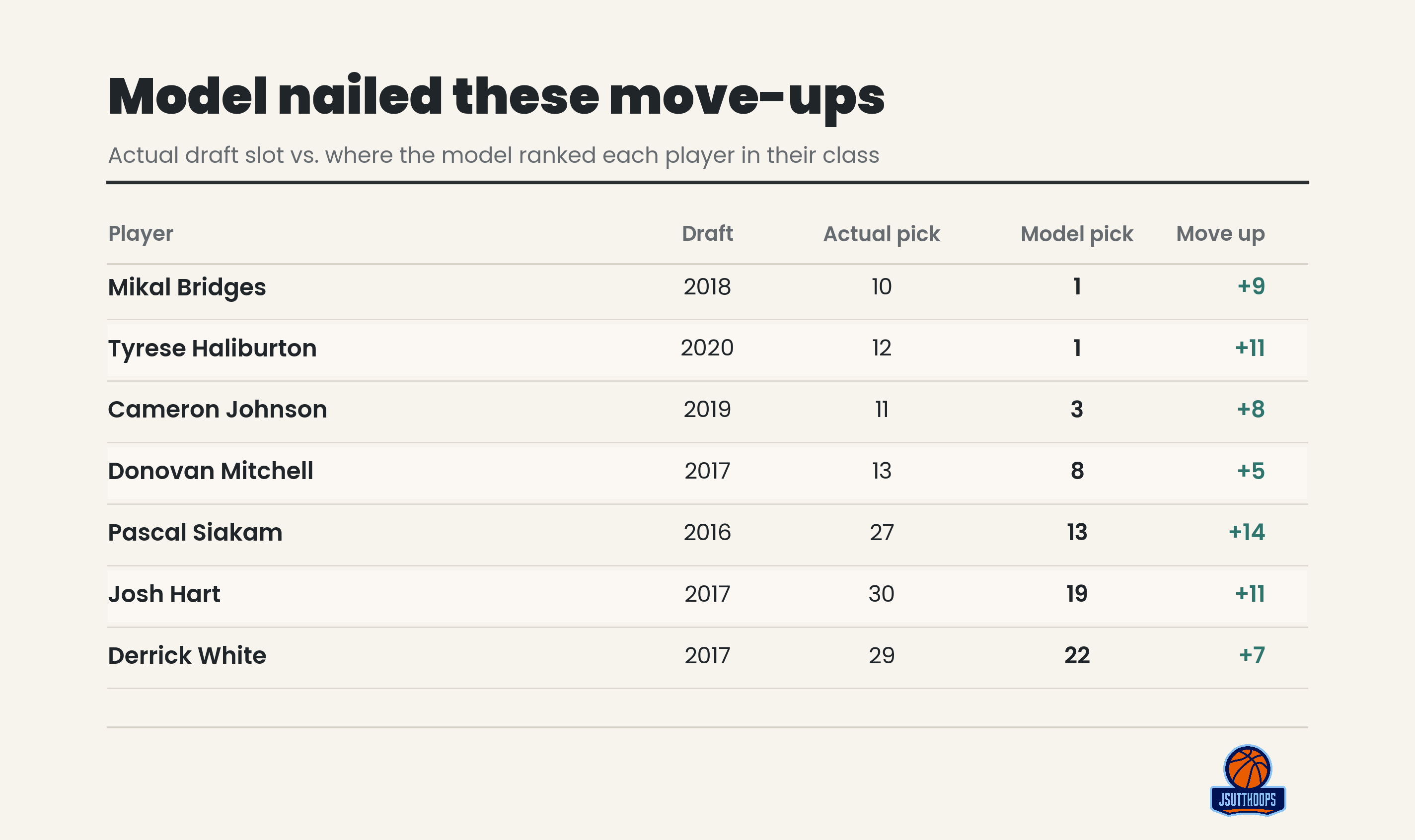
The Haliburton one is a big win, obviously. Though I wouldn’t say he’s better than Anthony Edwards, he’s certainly among the top-3 players in the class, so him sliding to #12 — after James Wiseman, Patrick Williams, and Killian Hayes were off the board — was a classic case of the market being wrong. Mikal Bridges and Cam Johnson, too, are big hits, as are Mitchell and Siakam. Then, even when the model doesn’t put a player in the lottery, such as Josh Hart or Derrick White, they’re still being successfully identified as better than consensus.
Let’s look at the flip side as well: Players who were successfully identified as being worse than their pick slots would imply.
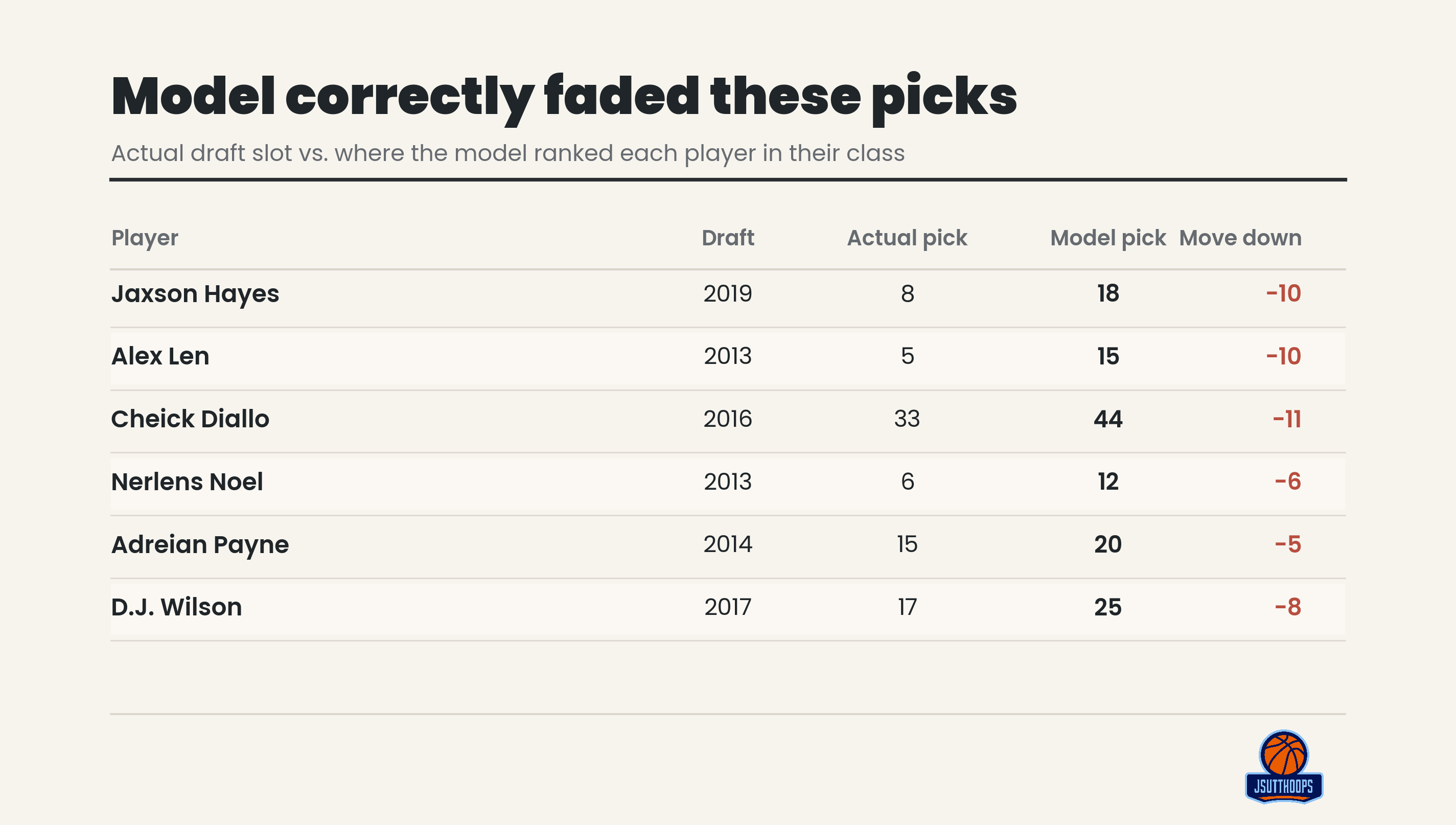
I don’t need to explain too much about the above. Jaxson Hayes has been far worse than a #8 pick (and was picked before Cam Johnson, who we identified as a riser via this model, while Alex Len is in the same boat.
But it’s not all sunshine and rainbows, certainly not with draft modeling. I’d be committing statistical malpractice if I didn’t show you the players it was wrong about:
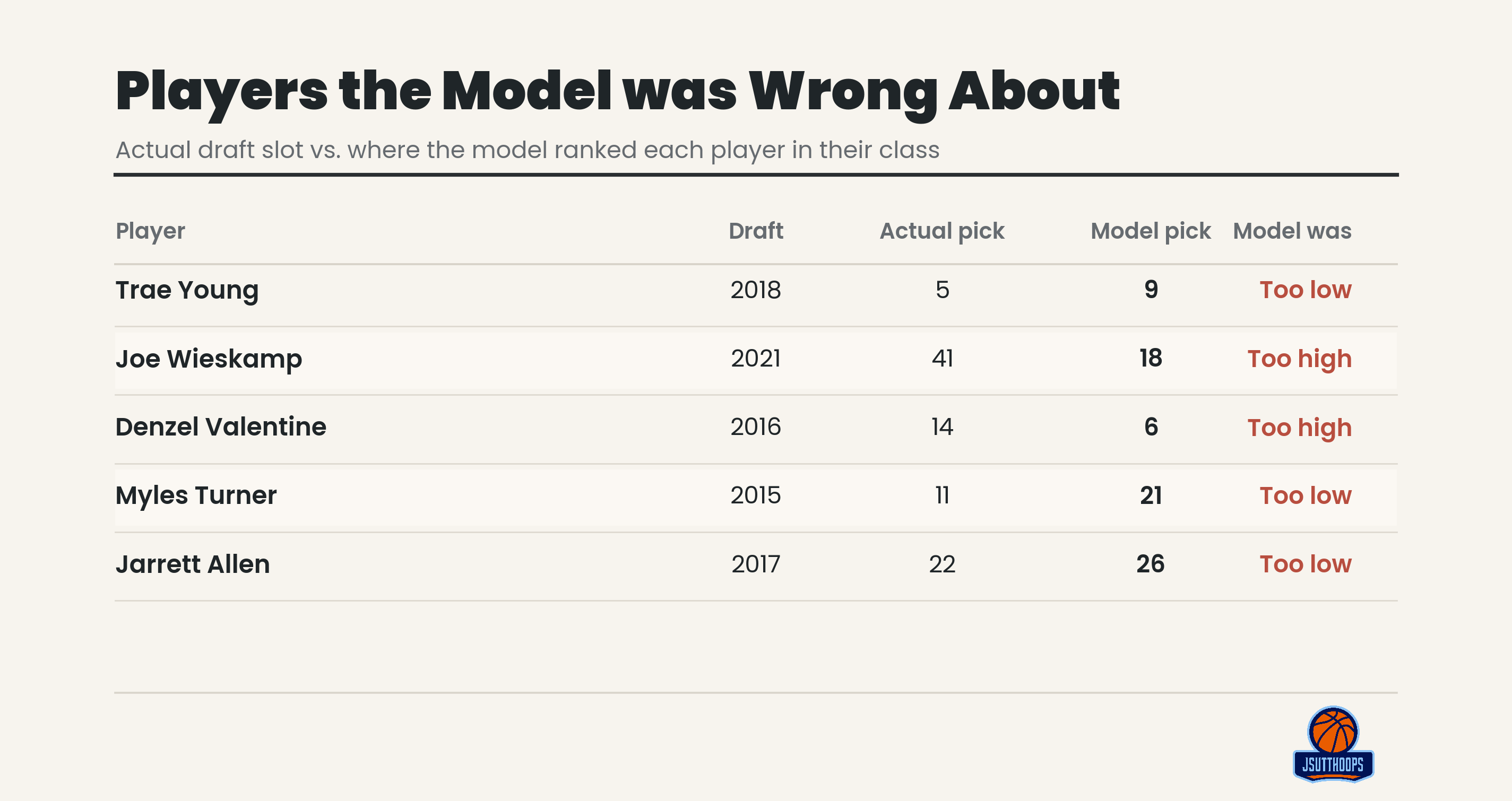
The Trae Young one is problematic, as is Wieskamp, who was certainly not worthy of being #18. So it’s not perfect, and while no model is, it’s worth noting!
Overall, the model is about 8% better on average at ranking players by their overall impact (Real Adjusted Plus-Minus being the target here, with some balance added by availability/expected minutes) than front offices are, and is strongest in predicting the lottery and second-round.
For example, historically, the chances of a player in the 16-30 becoming top-15 by impact has been 39.3%. This model gets it right 46.4% of the time, a relative lift of +18.3%. Hence, when the model projects a player is going to be in the top-15 despite being mocked in the latter half of the first, it’s worth taking note.
Now, with that out of the way, here is the full two-round model, and some comments on specific risers, fallers, and players of intrigue. Let’s start off with a huge leap to #1…
*It’s worth noting I do not have international players plugged in here yet, as that would require a separate model. Hence, no Karim Lopez. A plus sign means that the model was higher on the player than consensus (and the number is by how much), and vice-versa.
